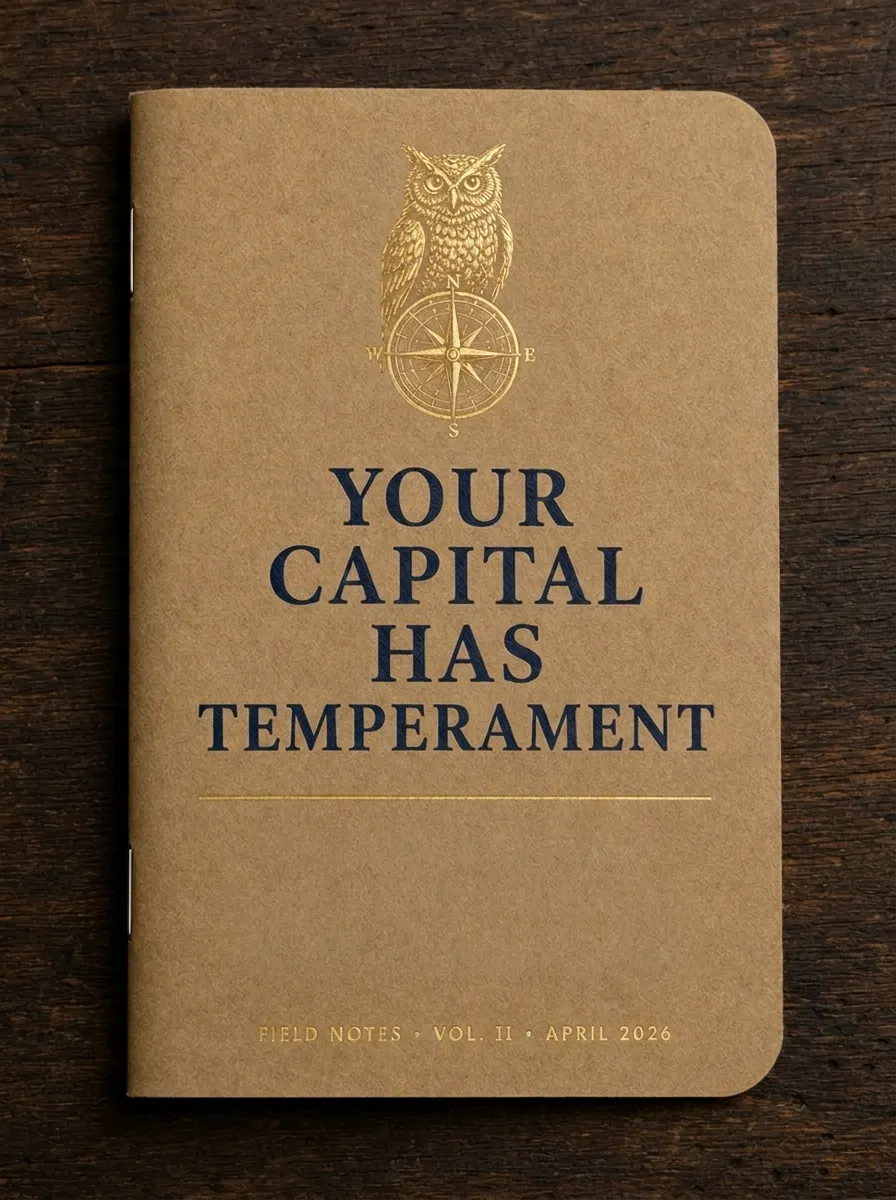
Money isn't fungible the way the textbook says. A dollar in your emergency fund, a dollar in your 401(k), a dollar of unvested RSUs, and a dollar of after-tax bonus cash are all called the same thing on the page — but they don't behave the same way in your life, and they don't deserve the same treatment. Each one has a different psychological cost when it moves, a different tax treatment when it moves, and a different range of vehicles where it actually belongs.
Think of capital the way an operator thinks of crews. You don't ask the framing crew to do the finish carpentry. They could probably do it adequately, but you're paying them to do what they're best at, and they get worse the longer you ask them to do something else. Your capital is the same. Hot capital — restless, growth-seeking, comfortable with drawdown, oriented toward equity-like returns — does its best work in equity-like positions. Cool capital — patient, defensive, focused on income and preservation — does its best work in income-producing real assets, fixed-income vehicles, or simply staying liquid. Use them in the wrong roles and you get mediocre results from both.
The trap most high earners fall into is treating all of their capital like the kind they had first. Whatever kind of money built the pile becomes the default template. If you spent a decade dollar-cost-averaging into index funds, every new dollar looks like another dollar of index fund. If you came up through company equity, every new dollar feels like it wants to be in concentrated equity. The pattern repeats until you have a portfolio that's heavily skewed toward one temperament — not because that's where your capital should be, but because that's where it landed.
The four-question filter that tells you which bucket a new dollar belongs in: First, what's the time horizon — when, realistically, would you want this dollar back? Second, what's the drawdown tolerance — what percentage decline would cause you to make a decision you regret? Third, what role does it play in the overall portfolio — is it producing income, growing, defending, or providing optionality? Fourth, what does the tax treatment do to the after-tax return — is the wrapper helping or hurting?
Most dollars that come through a high-earner's life land in the wrong bucket the first time. That's not a moral failure. It's the natural drift of capital toward the path of least resistance — usually whichever account has the lowest friction to add to. The work is in periodically auditing where everything sits and asking whether each bucket is doing the job its temperament is best suited for. The answer changes more often than most people expect.
The bucket that compounded you up the W-2 ladder — the one that quietly held most of your liquid net worth through your thirties — is almost never the right place to leave the next dollar in your forties. Not because it's a bad bucket, but because it's already doing the job it does best. Adding to it past the point of marginal benefit is how high-earner portfolios end up with all the same temperament and none of the diversification that actually matters.